Art Journaling: Where to Start When You’re Not an Artist
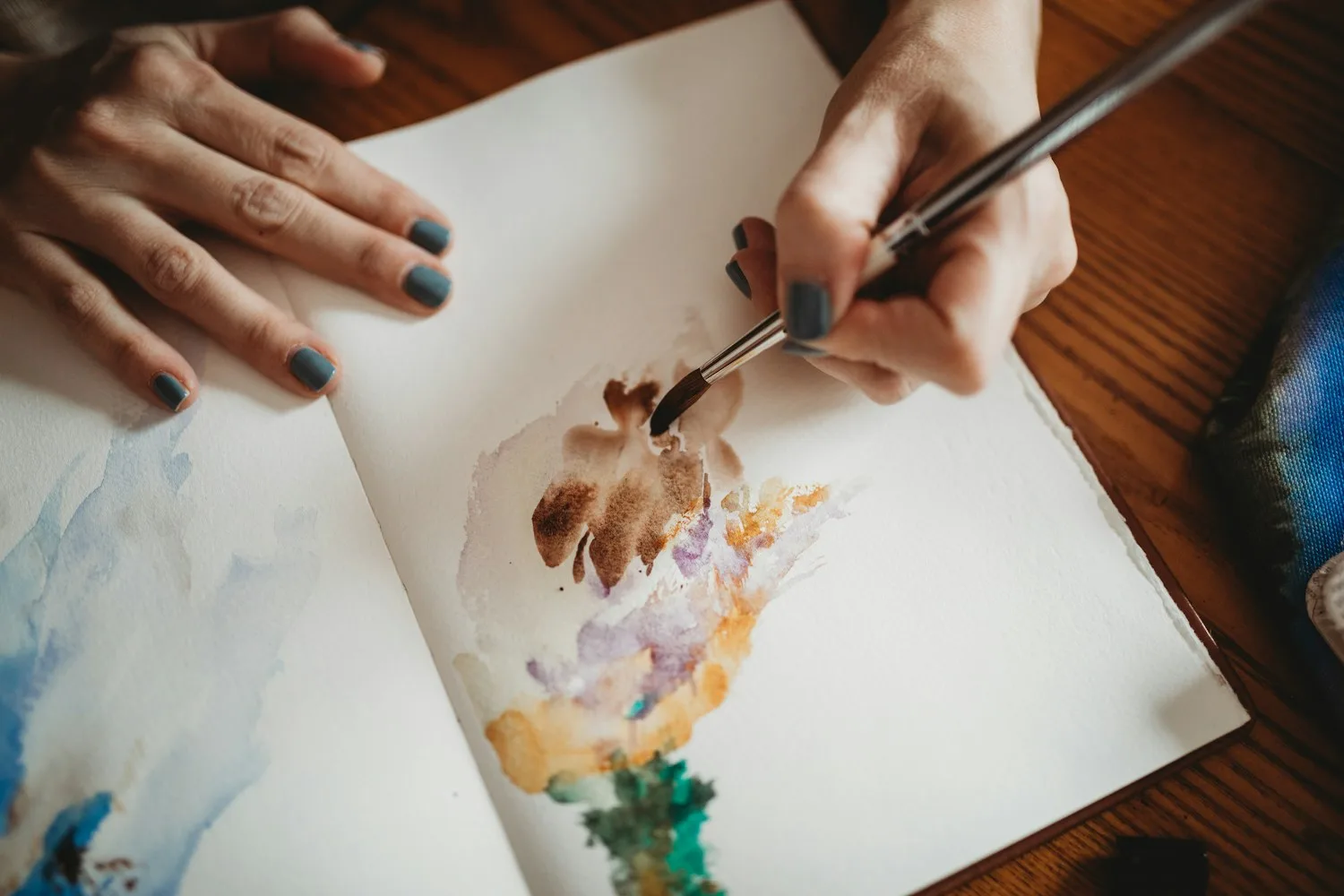
Art journaling is a notebook, some colour, and no plan.
That’s deliberately unglamorous, because the single biggest obstacle people bring to it is the belief that they need to be able to draw. You don’t. Nothing here is graded, and nobody is going to look at it.
What art journaling actually is
An art journal is a private book where you put down colour, line, shape, scraps and occasional words — not to produce something, but to have somewhere to go when language runs out.
It sits close to art meditation: simple, repetitive creative motion used as an anchor for staying present, the way breath anchors a seated practice. Attention rests on the hand moving and the small choices unfolding on the page.
The page is not the point. Where the making takes you is the point.
Starting when you’re not an artist
Especially then, in fact. People who can draw often have the harder time, because skill brings judgement with it.
What you need: a plain unlined notebook with paper thick enough not to bleed through, and one or two things that make marks. Cheap wax crayons work. A single pencil works. Do not go shopping for supplies — it’s the most common way to spend three weeks not starting.
Your first session, in full:
- Open to a page and give yourself ten minutes.
- Pick a colour without deciding why.
- Make a mark. Then another. Let your hand keep moving.
- When you notice you’re trying to make it look like something, stop trying and keep moving.
- Close the book when the time is up.
Don’t photograph it. Don’t evaluate it. Don’t show anyone. The privacy is doing structural work here.
Prompts, for the days the page is too blank
Use these as starting points, not assignments:
- What colour is this week?
- Fill the page with one repeated shape until the ten minutes are gone.
- Draw the weight of what you’re carrying. Not the thing — the weight.
- Put down where you felt most alive today, and where you felt most drained, without words.
- Cover the page entirely in one colour. Then respond to it.
- Make a mark for each thing you didn’t say out loud today.
If a prompt feels like homework, abandon it. The resistance is more informative than the exercise.
What tends to come up
Self-consciousness first, almost always. A running commentary about doing it wrong, wasting paper, being ridiculous.
Let that voice talk. It usually tires before you do.
Underneath it, people often find things arriving sideways — a memory attached to a colour, a grief that had been filed neatly away, an old agreement about themselves that they’d forgotten making. This is why the practice is worth repeating on the days it feels pointless. What surfaces rarely arrives on the first invitation.
Keeping it going
- Short and regular beats long and occasional. Ten minutes several times a week will do more than an afternoon once a month.
- Same time, roughly. The practice survives on habit, not inspiration.
- Never skip a page because the last one was bad. There are no bad ones. There are only pages.
- Don’t start a new notebook. The urge to begin again more beautifully is the practice avoiding itself.
What this is not
Art journaling here is a contemplative practice, not clinical treatment.
That distinction matters: art therapy is a licensed profession, practised by a licensed art therapist as a form of psychotherapy, with training in interpreting what emerges. This isn’t that, and isn’t a substitute for it. Nobody is going to analyse your page.
It sits perfectly well alongside therapy you’re already doing.
Where it leads
For some people a notebook is the whole practice, permanently, and that’s a complete answer.
For others it opens a door to the rest of it — to visio divina, to contemplative prayer, to the wider ground of contemplative practice. Often it’s the gentlest way in, precisely because it asks nothing of your beliefs and very little of your time.
If you’d like a voice alongside the making, the three guided meditations here are free and short, each published with its full written script.
And if you’d rather not do it alone, get in touch. Sessions build around whatever meets you where you are.
Not sure which door is yours today?
Explore the three paths — Healing, Being, and Searching — and find the one that meets you where you are.