Taizé Prayer: What It Is and How to Pray It at Home
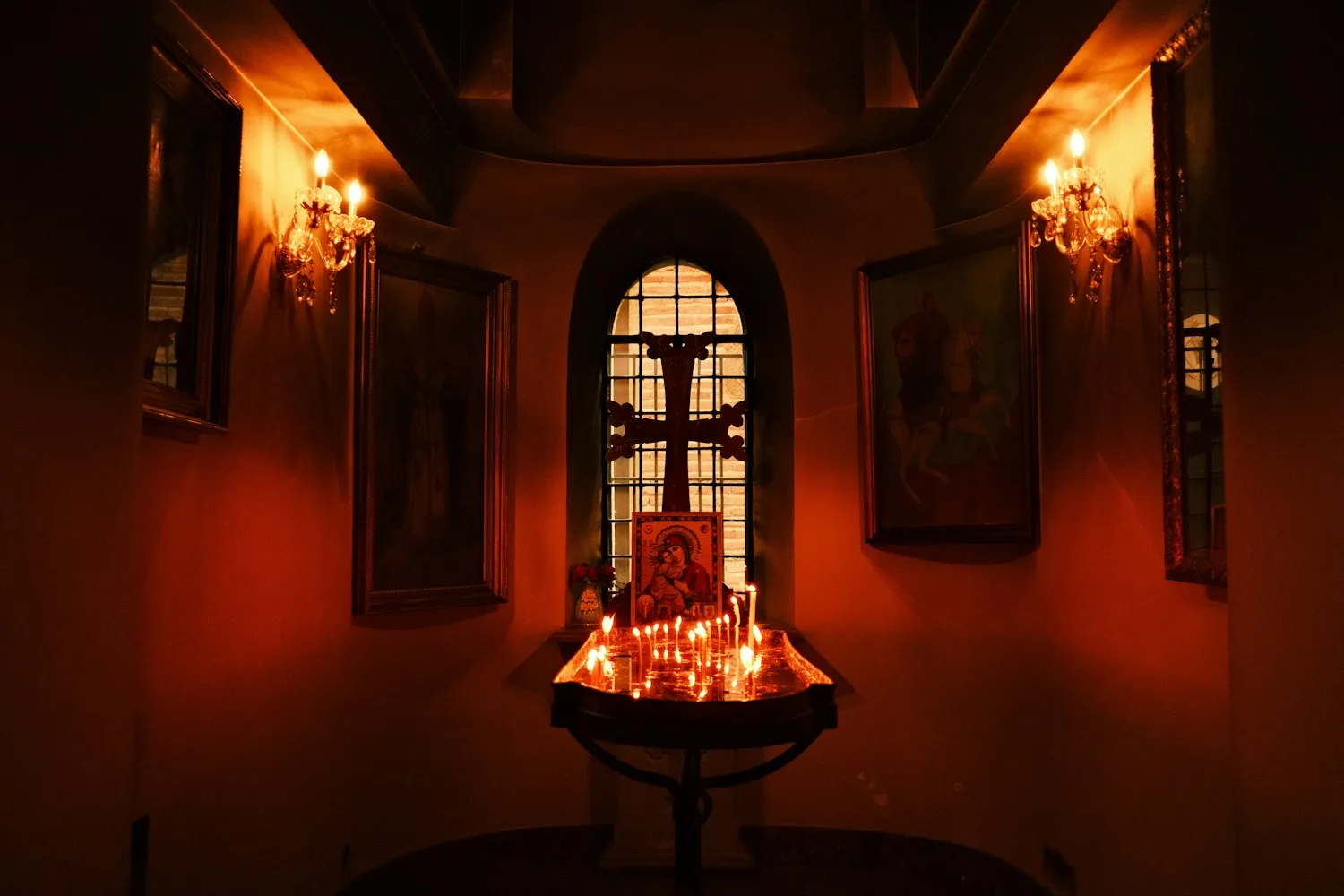
You walk into a dim church on a weekday evening. A few candles, an icon, a simple cross. Someone starts to sing a single line — and then sings it again, and again, and the room slowly joins in. Ten minutes later the singing stops and nobody speaks. That, more or less, is Taizé prayer.
This guide explains where it comes from, how a service is shaped, and how to pray in this way at home, alone or with a few friends.
What is Taizé prayer?
Taizé prayer (sometimes written “Taize”, and pronounced roughly teh-ZAY) is a simple, sung form of meditative Christian prayer. It is built from short songs repeated many times, a psalm, a short reading from Scripture, one long silence and a few spoken prayers. There is no sermon and very little talking.
It takes its name from Taizé, a small village in Burgundy, France, where an ecumenical monastic community has lived since 1940. The community itself describes its sung prayer like this: “Short songs, repeated again and again, give it a meditative character. Using just a few words they express a basic reality of faith, quickly grasped by the mind.”
The songs are not there to entertain or to teach, but so that the words can sink in slowly. It belongs to the wider family of contemplative prayer: less about saying things to God, more about resting in God’s presence.
Where it comes from
In August 1940, at the age of 25 and with the Second World War under way, a young Swiss Protestant named Roger Schutz went looking for a house in France, in a region then marked by the distress of the war. He settled in Taizé. Brothers gradually joined him, and Brother Roger, as he became known, led the community until his death in August 2005, at the age of 90.
Today the community describes itself as “around eighty brothers from different church backgrounds – Catholic, Anglican, Protestant – and from nearly thirty countries.” Over the decades, growing numbers of young people came to pray with the brothers, and the community needed a way of praying that everyone could join, whatever their language or church.
The answer was the music. The French composer Jacques Berthier was first asked to write for the community in 1955, and again in 1975, this time for chants that large numbers of young visitors could sing together. Many of the best-known Taizé songs are his, alongside pieces by Joseph Gelineau and by the brothers themselves. Some are in Latin, which oddly makes them easier to share: nobody is singing in their own language, so everybody is.
What happens in a Taizé prayer service
The Taizé community’s own guide to preparing a time of prayer suggests a simple order. Local churches adapt it, but most services follow this shape:
- One or two songs of praise to open.
- A psalm, often read or sung by one voice with everyone singing a short response.
- A reading from Scripture, kept short.
- A song to let the reading settle.
- Silence — usually one long silence of five to ten minutes rather than several short ones.
- Intercessions or a litany of praise, short prayers with a sung response such as Kyrie eleison.
- The Lord’s Prayer.
- A concluding prayer.
- More songs, which often carry on for a long time; people stay or slip away as they need to.
The setting is simple: the community suggests turning towards the altar or icons, and candles are common. If you have tried visio divina, you will recognise the role of the icon — something to rest your eyes on while the words do their quiet work.
The silence is the heart of it
For many first-timers the silence is the surprise. The community’s guide puts it gently: “The voice of God is often heard only in a whisper, in a breath of silence.” The songs before it are, in a sense, preparing you to be able to stay in it. If your mind wanders, that is normal; let the last song keep playing quietly inside you and come back to it.
The songs
You do not need to read music or have a good voice. Most songs are one or two lines long. A few that you will often hear in English-speaking churches:
- Jesus, remember me — the words of the man crucified beside Jesus (Luke 23:42).
- Bless the Lord, my soul — from Psalm 103.
- Ubi caritas — an ancient Latin hymn: “where charity and love are, God is there.”
- Nada te turbe — Spanish words from Teresa of Ávila: “let nothing disturb you.”
- Wait for the Lord — often sung in Advent.
Recordings are easy to find, and the community has a section about its songs on its own website.
How to pray Taizé-style at home
You do not need a church, a choir or a musician. Here is a simple version you can practise this week.
1. Prepare a small space
A candle, a cross or an icon, a Bible open at the reading. Decide beforehand how long you will stay — twenty to thirty minutes is plenty.
2. Choose two or three songs
Pick songs you can hum after a couple of listens. If singing alone feels strange, play a recording and simply listen.
3. Begin with a song, repeated
Sing (or listen to) one song several times. Do not count. Let it go on until you notice you have stopped thinking about the words and started meaning them.
4. Pray a psalm
Read a few verses of a psalm slowly, aloud if you can. Psalm 23, 62 or 131 are good places to start.
5. Read a short passage
Keep it brief — a few verses from the Gospels is enough. If you know lectio divina, you may notice a word or phrase standing out. You do not need to do anything with it yet; carry it into the silence.
6. Rest in silence
Five to ten minutes. Set a gentle timer so that you are not checking the clock. If thoughts come, let them pass and return to the words of the last song or the phrase from the reading.
7. Pray for others
Name a few people and situations briefly, with a short response such as Kyrie eleison between each.
8. Close with the Lord’s Prayer and a final song
Say the Lord’s Prayer, then sing a last song for as long as feels right.
Taizé prayer on one page
Before you start: a candle, a cross or icon, two or three short songs, a psalm, a short reading, a timer.
- Song — repeat it until you stop counting.
- Psalm — a few verses, read slowly.
- Reading — a short passage; notice one phrase.
- Song — let the reading settle.
- Silence — five to ten minutes.
- Prayers for others — short, with a sung or spoken response.
- Lord’s Prayer and a closing prayer.
- Songs — for as long as you like.
Twenty to thirty minutes. Alone or with a few others. No skill required.
What Taizé prayer isn’t
- It isn’t therapy. Many people find the songs and silence calming, but this is prayer, not a treatment. If you are struggling with your mental health, please speak to a doctor or a qualified therapist.
- It isn’t a concert. There is no audience. If there are musicians, they are there to hold the pitch and the tempo, not to perform.
- It isn’t a technique for emptying the mind. The silence is not about achieving a blank state; it is about attending to God, distractions and all.
- It isn’t tied to one denomination. Catholic parishes, Anglican and Episcopal churches, Lutheran, Methodist and Reformed congregations all hold Taizé services.
Taizé prayer in Advent
Advent, which begins on Sunday 29 November 2026, is a season of waiting, and these short, patient songs are a kind of waiting set to music. For a simple rhythm, you could pray the home version above on each Sunday evening of Advent, lighting one more candle each week. Many churches also hold Taizé services in Advent and Lent.
Where to go from here
If the silence drew you, you might explore contemplative practice more widely, or spend longer in quiet on a silent retreat (here is what to expect on a contemplative retreat). There are also guided meditations on this site.
If you would like to talk about finding a way of praying that fits your life, you are welcome to get in touch.
Frequently asked questions
What is Taizé prayer?
Taizé prayer is a meditative form of Christian worship from the ecumenical community of Taizé in France. It combines short sung chants repeated many times, a psalm, a Scripture reading, a long silence of five to ten minutes and simple intercessions.
Is Taizé prayer Catholic?
It is ecumenical rather than belonging to one church. The Taizé community includes Catholic, Anglican and Protestant brothers, and Taizé-style services are held in Catholic parishes as well as in many Protestant and Anglican churches.
Is Taizé prayer biblical?
Yes. Most of the songs use words from Scripture or from the Church’s long tradition of prayer, and the usual order includes a psalm and a Bible reading. “Jesus, remember me”, for example, is taken from Luke 23:42.
How long is a Taizé prayer service?
There is no fixed length: the Taizé community says meditative singing lets people pray together “without having to fix the length of time too exactly”. Many parish services last under an hour, and the closing songs often continue while people stay or leave quietly. At home, 20 to 30 minutes is plenty.
How do you pronounce Taizé?
Roughly “teh-ZAY”, with the stress on the second syllable. It is the name of the French village where the community lives.
Can I pray Taizé prayer on my own?
Yes. Follow the same shape — song, psalm, reading, silence, prayers, Lord’s Prayer, song — and let a recording carry the singing if you prefer.
Do I need to be able to sing?
No. The songs are deliberately short and simple so that anyone can join in after hearing them a few times. Humming, listening or simply being present are all part of it.
Not sure which door is yours today?
Explore the three paths — Healing, Being, and Searching — and find the one that meets you where you are.