What Is Centering Prayer? The Four Steps, Explained
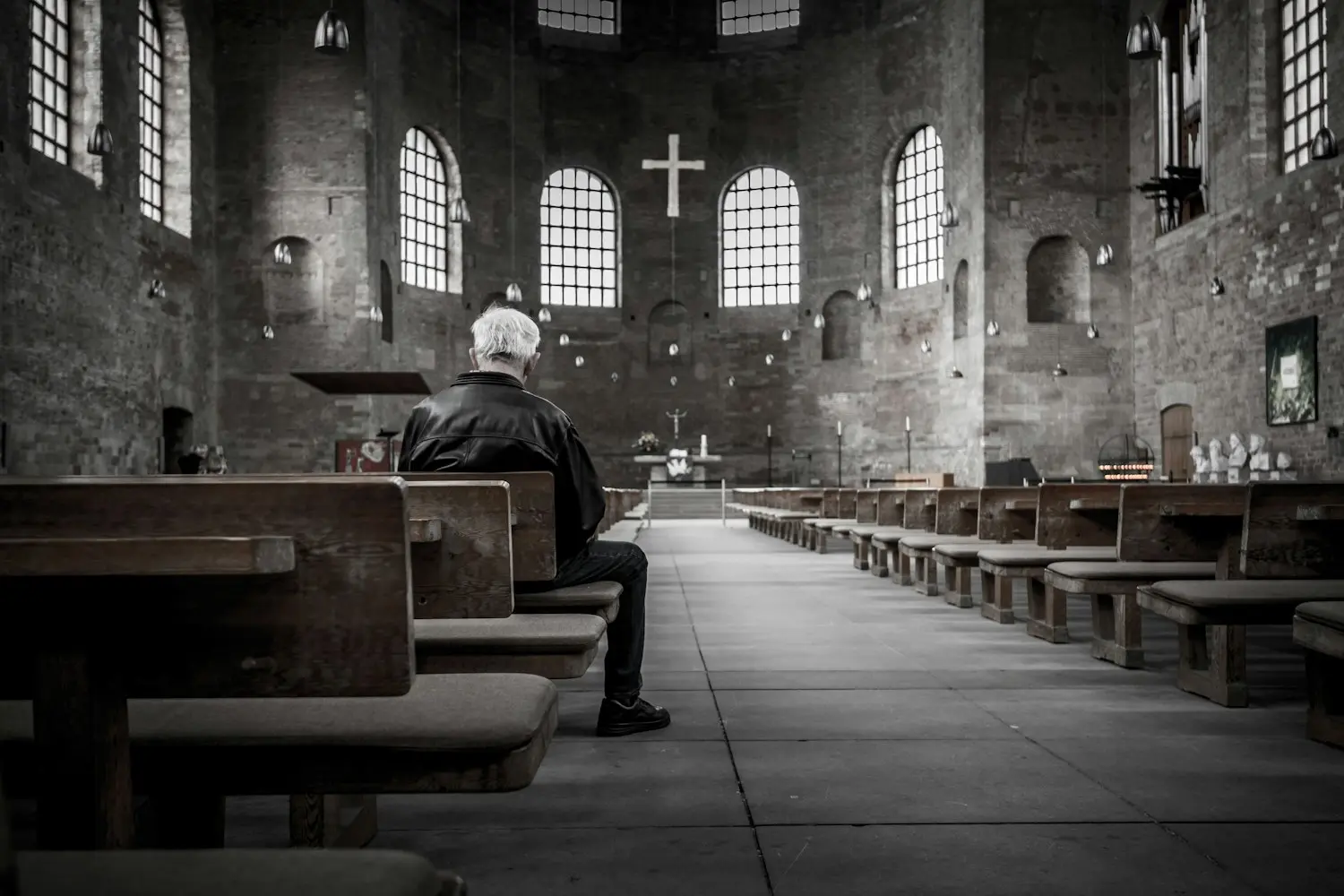
Centering prayer is a simple, silent way of praying. You sit for around twenty minutes, let go of words and ideas, and use a short “sacred word” to express your consent to God’s presence. When you notice you’re caught up in thoughts, you return to the word, gently. That is almost all there is to it.
This guide explains where centering prayer comes from, how to do it step by step, how to choose a sacred word, and how it differs from contemplative prayer, meditation and mindfulness.
What is centering prayer?
Centering prayer is a Christian method of silent prayer developed in the 1970s by three Trappist monks at St Joseph’s Abbey in Spencer, Massachusetts: Fr William Meninger, Fr M. Basil Pennington and Fr Thomas Keating. It is taught today by Contemplative Outreach, the network Keating co-founded, and practised by Catholics, Episcopalians, Methodists, Lutherans and many others.
It isn’t a way of thinking about God, or of talking to God. It is a way of making yourself available. Contemplative Outreach describes the sacred word as “the symbol of your intention to consent to God’s presence and action within.” You are not trying to achieve a state or make something happen. You are saying yes, quietly, for twenty minutes, and letting go of everything else.
The name was taken from Thomas Merton, who described contemplative prayer as prayer “centered entirely on the presence of God.”
Where centering prayer comes from
The method is modern, but the roots are old. Its teachers saw it as a way of making the contemplative tradition of the early Church accessible to ordinary people again, not as something new.
The Cloud of Unknowing
The most direct source is The Cloud of Unknowing, an anonymous English book on prayer written in the fourteenth century. Its author tells the reader that God cannot be grasped by thinking, only by love, and suggests taking “a little word of one syllable” — such as “God” or “love” — and fastening it to your heart, so that whenever thoughts crowd in, you can let them go with that one word.
Behind the Cloud stand older voices: the Desert Fathers and Mothers of fourth-century Egypt, John Cassian, who taught monks to repeat a single verse of a psalm throughout the day, and later the Spanish mystics Teresa of Ávila and John of the Cross, both of whom wrote about a prayer of quiet that is received rather than produced.
The scriptural foundation most often given is Jesus’ instruction in Matthew 6:6: “when you pray, go into your room and shut the door and pray to your Father who is in secret.” Psalm 46:10, “Be still, and know that I am God”, is the other verse you will hear again and again.
Three monks at St Joseph’s Abbey
In the 1970s, Thomas Keating was abbot of St Joseph’s Abbey, a Trappist monastery in Massachusetts. Young people were coming to the abbey’s door asking about meditation, many of them already practising in Eastern traditions, and often unaware that Christianity had a contemplative tradition of its own. Keating asked the monks whether that tradition could be put into a form anyone could learn.
William Meninger drew on The Cloud of Unknowing and began teaching a simple method to priests on retreat. Basil Pennington taught it widely, too. Keating shaped the method and, over the following decades, wrote about it more than anyone else. In 1983 the first intensive centering prayer retreat was held, and in 1984 Keating co-founded Contemplative Outreach to support people practising it. His book Open Mind, Open Heart (1986) became the standard introduction. Keating died on 25 October 2018, at St Joseph’s Abbey.
How to do centering prayer: the four guidelines
Contemplative Outreach teaches the method in four short guidelines. Here they are, with a little explanation for each.
1. Choose a sacred word
Choose a sacred word as the symbol of your intention to consent to God’s presence and action within. A word of one or two syllables works best. (There is more on choosing one below.) Choose it before you start, not during the prayer.
2. Settle, and introduce the word
Sitting comfortably and with eyes closed, settle briefly and silently introduce the sacred word. Sit upright but relaxed, in a chair or on a cushion, whatever lets you stay still without strain. Then let the word come, softly. It’s not a mantra to repeat continuously; it is more like turning towards someone.
3. Return ever-so-gently to the word
When you notice you are engaged with your thoughts, return ever-so-gently to the sacred word. “Thoughts” here means anything at all: plans, memories, feelings, sounds, images, even spiritual insights. You will drift. Everyone does. Each drift is simply another chance to return, and the returning is the prayer.
4. Rest in silence at the end
At the end of the prayer period, remain in silence with eyes closed for a couple of minutes. This gives you a gentle way back into ordinary life. Some people pray the Lord’s Prayer slowly in their minds during these minutes.
How long, and how often?
The recommendation from Contemplative Outreach is a minimum of twenty minutes, twice a day: once in the morning and once in the afternoon or early evening. If that feels like a lot, begin with ten minutes once a day and build up slowly. Use a gentle timer — a soft chime rather than an alarm — so you aren’t checking the clock. Contemplative Outreach also publishes a free timer app for centering prayer.
Choosing your sacred word (with examples)
The sacred word is not magic, and its meaning matters less than you might expect. What it carries is your intention. That is why teachers suggest a simple word that doesn’t set your mind off thinking about it.
Words people often use include:
- Names for God: God, Jesus, Abba, Father, Mother, Spirit
- Words of consent: Yes, Amen, Here, Open
- Words of rest: Peace, Be still, Stillness, Silence, Let go
- Words of relationship: Love, Mercy, Trust, Faith
A few practical points:
- Keep the same word for the whole prayer. Changing it mid-session turns the word into something to think about.
- Keep it for a while. Give a word weeks, not days, before deciding it isn’t right.
- Don’t look for the perfect word. If you find yourself weighing up options, choose the shortest one that feels honest and begin.
- A word isn’t the only option. Some people use a simple inward glance towards God, or noticing the breath, as the symbol of their consent instead.
Centering prayer on one page
Before you start: a chair or cushion, a quiet spot, a gentle timer set for twenty minutes, and a sacred word chosen in advance.
- Choose a sacred word as the symbol of your consent to God’s presence and action within.
- Settle: sit comfortably, close your eyes and silently introduce the word.
- Return: when you notice you are engaged with thoughts, come back ever-so-gently to the word.
- Rest: when the timer sounds, stay in silence with eyes closed for a couple of minutes.
Twenty minutes, twice a day. Resist no thought, retain no thought, react to no thought. Return ever-so-gently to the sacred word.
Centering prayer vs contemplative prayer
People often use these two names as if they meant the same thing. They are closely connected, but they aren’t the same.
Contemplative prayer, the wider tradition, is the whole long Christian practice of resting in God beyond words and images. Most teachers in that tradition describe contemplation as a gift: something you can make room for, but cannot produce. Centering prayer is one specific method of making room. Keating himself was clear that centering prayer is a preparation for contemplative prayer rather than a replacement for it.
A simple way to hold it: centering prayer is the door; contemplative prayer is the room.
Here is how centering prayer sits alongside some of its neighbours:
| What it is | What you rest on | Typical length | Where it comes from | |
|---|---|---|---|---|
| Centering prayer | A method with four guidelines | A sacred word, as a sign of consent | 20 minutes, twice a day | Trappist monks, Massachusetts, 1970s; rooted in The Cloud of Unknowing |
| Contemplative prayer | The wider tradition, and the gift itself | God’s presence, beyond words | Any | The whole Christian contemplative tradition |
| Lectio divina | Praying slowly with a text | A word or phrase from Scripture | 15–20 minutes | Monastic tradition; named in four steps by Guigo II, 12th century |
| Jesus Prayer | A short prayer repeated slowly | “Lord Jesus Christ, Son of God, have mercy on me” | Any, often through the day | Eastern Orthodox tradition |
Centering prayer and lectio divina
The two are often practised together. The final movement of the four steps of lectio divina, contemplatio, is a resting in God beyond the words of the text. Centering prayer was designed in part to help people stay in that resting for longer. Many people use lectio divina to begin the day and centering prayer to deepen it.
Is centering prayer meditation or mindfulness?
From the outside, it looks similar: someone sitting still with their eyes closed. On the inside, it’s different. Mindfulness trains attention, often on the breath or on the present moment. Many forms of meditation, including Transcendental Meditation, use a mantra as a focus for concentration. Centering prayer does neither. The sacred word is not something you concentrate on; it expresses your consent to a relationship. You aren’t trying to empty your mind or become calm. You are letting go of thoughts so that you can be with God.
That said, there is no need to set these practices against one another. Many people find that centering prayer gives a home to the stillness they first discovered somewhere else.
What to do with thoughts
This is the part that worries beginners most, so it is worth being clear: thoughts are not a failure. You will have hundreds of them in twenty minutes. The prayer isn’t spoiled by them.
Keating’s teaching is often summarised in four phrases:
- Resist no thought. Don’t fight them or push them away.
- Retain no thought. Don’t hold on to them, however interesting.
- React to no thought. Don’t judge yourself for having them.
- Return ever-so-gently to the sacred word.
Keating used the image of boats on a river: you are sitting on the bank, and thoughts float past. You don’t need to climb into any of them. When you notice you have climbed in, you step back onto the bank, using the sacred word. There is a story, often told by his students, of a nun who came to him after her first session dismayed: she had had ten thousand thoughts in twenty minutes. “How lovely,” he replied. “Ten thousand opportunities to return to God.”
Sometimes difficult feelings or old memories surface in the silence. Keating described this as part of a slow healing of what he called the “false self”, and called the whole process a kind of “divine therapy”. That is his spiritual language, though, not a clinical one. Centering prayer isn’t a substitute for mental health care. If what comes up feels overwhelming, it is wise to stop, to talk to someone you trust, and to seek support from a doctor or therapist if you need it.
Is centering prayer Catholic? Is it biblical?
Centering prayer was developed by Catholic monks and draws deliberately on Catholic sources: the Desert Fathers, The Cloud of Unknowing, Teresa of Ávila and John of the Cross. It is taught in many Catholic parishes and retreat houses, and also in Episcopal, Anglican, Methodist, Lutheran and other churches.
It also has critics. Some Catholic writers, including Connie Rossini in Is Centering Prayer Catholic?, argue that it is too close to Eastern meditation techniques and too empty of content. They point to the Congregation for the Doctrine of the Faith’s letter On Some Aspects of Christian Meditation (15 October 1989), signed by Cardinal Joseph Ratzinger, which cautioned against importing methods from Eastern religions into Christian prayer without discernment.
The letter doesn’t mention centering prayer or Keating by name, and Keating held that its cautions didn’t apply to the method, which he saw as a preparation for contemplation, a gift of the Holy Spirit, rather than a technique for producing it. The disagreement continues. If you are Catholic and unsure, it is reasonable to talk it through with a priest or spiritual director you trust.
As for whether it is biblical: centering prayer doesn’t take its method from a single verse, but its teachers ground it in Matthew 6:6 (praying “in secret”), Psalm 46:10 (“Be still, and know”) and the long scriptural theme of waiting on God in silence.
Practising with others: groups and retreats
Centering prayer is usually practised alone, but many people find it easier to keep going with others. Centering prayer groups typically meet weekly for a short reading, twenty minutes of silent prayer together, and sometimes a brief sharing. Contemplative Outreach keeps a directory of groups in many countries, and some meet online.
Longer stretches of silence can also help the practice take root. A silent retreat gives you time to pray several periods in a day without the usual interruptions (here is what to expect on a contemplative retreat). Other forms of shared silent prayer, like Taizé prayer, where silence is held between songs, can be a gentle way in, too.
Where to go from here
If silence with a word draws you, you might also like praying with an image, or exploring contemplative practice more widely. There are also guided meditations on this site.
If you would like to talk about finding a way of praying that fits your life, you are welcome to get in touch.
Further reading
- Thomas Keating, Open Mind, Open Heart (1986) — the classic introduction to the method.
- Thomas Keating, Intimacy with God — on the wider spiritual journey centering prayer opens.
- Cynthia Bourgeault, Centering Prayer and Inner Awakening — a clear, practical guide by one of Keating’s best-known students.
- M. Basil Pennington, Centering Prayer: Renewing an Ancient Christian Prayer Form.
- The Cloud of Unknowing — the fourteenth-century source, available in several modern translations.
- Contemplative Outreach (contemplativeoutreach.org) — the method, its history, and a directory of groups.
Frequently asked questions
What is centering prayer, in simple terms?
Centering prayer is a silent Christian prayer method in which you sit for around twenty minutes and consent to God’s presence, using a short “sacred word” to let go of thoughts. It was developed in the 1970s by Trappist monks Thomas Keating, William Meninger and Basil Pennington at St Joseph’s Abbey, Massachusetts.
What is the difference between centering prayer and contemplative prayer?
Contemplative prayer is the wider tradition of resting in God beyond words, which Christian teachers describe as a gift rather than a technique. Centering prayer is one specific method that prepares for that gift, with four simple guidelines and a sacred word. Centering prayer is the door; contemplative prayer is the room.
How do I do centering prayer, step by step?
Choose a sacred word as a sign of your intention to consent to God. Sit comfortably, close your eyes and silently introduce the word. When you notice you are engaged with thoughts, return ever-so-gently to the word. At the end, remain in silence for a couple of minutes. Twenty minutes, twice a day, is suggested.
What sacred word should I use?
Choose a short word of one or two syllables that expresses your intention to be open to God, such as God, Jesus, Abba, Love, Peace, Mercy, Amen or Yes. The meaning matters less than the intention behind it. Once you have chosen it, keep the same word for the whole session rather than changing it.
Is centering prayer Catholic? Is it safe?
Centering prayer was developed by Catholic Trappist monks and draws on The Cloud of Unknowing, Teresa of Ávila and John of the Cross. Some Catholic writers criticise it, citing the Vatican’s 1989 letter on Christian meditation, which doesn’t name the method; Keating held that the letter didn’t apply to it. Catholics, Episcopalians, Methodists and others practise it today.
Is centering prayer just meditation or mindfulness?
Not quite. Mindfulness and many forms of meditation train attention on the breath or the present moment. Centering prayer isn’t about concentration: the sacred word expresses consent to God’s presence, and you let thoughts go rather than focus on anything. It is relational prayer rooted in Christian tradition, even if it looks similar from outside.
Who created centering prayer?
Centering prayer took shape in the 1970s at St Joseph’s Abbey in Spencer, Massachusetts. Fr William Meninger drew on the fourteenth-century Cloud of Unknowing to teach a simple method. Fr Basil Pennington and Abbot Thomas Keating developed and spread it, and in 1984 Keating co-founded Contemplative Outreach to teach it worldwide.
How long should centering prayer last?
The usual recommendation is at least twenty minutes, twice a day: once in the morning and once in the afternoon or early evening. Beginners can start with ten minutes and build up. A gentle timer helps, so you aren’t checking the clock, and the final couple of minutes are spent resting in silence.
Not sure which door is yours today?
Explore the three paths — Healing, Being, and Searching — and find the one that meets you where you are.